Every since I've joined Rotary in 2012, there's always a new theme that aims to create a vision for Rotary that year. As a Rotarian, I try to incorporate those themes into my philosophy as a Rotarian over the years to enhance my vision, and serving others. This year our Rotary theme is "Rotary: Making A Difference," and I invite you to incorporate every Rotary theme you had been a part of, and embrace yourself to be called "Rotarian" by making a difference.
"Thousands of candles can be lighted from a single candle, and the life of the candle will not be shortened. Happiness never decreases by being shared." - Buddha
My vision this year is to create more opportunities for all members to be engage, and interact with each other. If you're new to Rotary, please don't hesitate to ask for help, and voice your opinion if there's something we could do to improve your experience in Rotary. We can only be a great club if everyone participates, talks, listen, and learn from each other. I started in Rotary knowing nothing except "The 4-ways test," but I did my research, talk to other Rotarians, browse through Rotary.Org, and try to connect other Rotary resources and this is how I've learned to become a Rotarian.
For those of us that are seasons Rotarian, please reach to our new Rotarian and be a mentor. I encourage you all to be the candle for one another, and together we can all become a blazing flame.
I look forward to making a difference with you all!
We will have Mike Bell, Community Engagement Manager from Rise Against Hunger to talk about his organization. This is the same organization that attended our Rotary International Conference in Atlanta and collaborates with Rotarians to put together over 100,000 food packages.
Rise Against Hunger is an international hunger relief organization that distributes food and life-changing aid to the world’s most vulnerable, mobilizing the necessary resources to end hunger by 2030.
I also like to mention one of my first priorities is to create the Newsletter Committee. As an e-Club, this is our bloodlines and the image we projected into social media, SEO (Search Engine Optimization)...etc. And more importantly, we need to utilize this tool to connect with each other. I invite you to join the Newsletter Committee or support the committee telling your story, your job, challenge you're facing, your Rotary's moment, or the currently project you're working on. We don't always get a change to know each other in person, but through these articles, I hope it can break the ice and create valuable connections for us to help each other. Please contact Robin Charlesworth, Lizette Odfalk, or myself you would like to join the Newsletter Committee or submit an article.
In 2017-18, we’ll answer the question “What is Rotary?” with RI President-elect Ian H.S. Riseley’s theme, Rotary: Making a Difference. “Whether we’re building a new playground or a new school, improving medical care or sanitation, training conflict mediators or midwives, we know that the work we do will change people’s lives — in ways large and small — for the better.”
The 2017-2018 theme, Rotary: Making a Difference, was announced at Rotary's International Assembly in San Diego, California, USA, on January 16, 2017. Learn more at http://on.rotary.org/2iy0mzZ
"2017-18 RI President Ian H.S. Riseley announces his presidential theme, Rotary: Making a Difference" - Notes below, are based on the Article: By Ryan Hyland
Rotary International 2017-18 President Ian H.S. Riseley made the case last January, that protecting the environment and curbing climate change are essential to Rotary’s goal of sustainable service.
Riseley, a member of the Rotary Club of Sandringham, Victoria, Australia, unveiled the 2017-18 presidential theme, Rotary: Making a Difference, to incoming district governors at Rotary’s International Assembly in San Diego, California, USA.
Environmental degradation and global climate change are serious threats to everyone, Riseley said. “They are having a disproportionate impact on those who are most vulnerable, those to whom Rotary has the greatest responsibility. Yet environmental issues rarely register on the Rotary agenda,” he said.
“The time is long past when environmental sustainability can be dismissed as not Rotary’s concern. It is, and must be, everyone’s concern,” he said.
The president-elect challenged every Rotary club to make a difference by planting a tree for each of its members between the start of the Rotary year on 1 July and Earth Day on 22 April 2018. Trees remove carbon dioxide and other greenhouse gases from the air, which slows global warming.
“It is my hope that the result of that effort will be far greater than the environmental benefit that those 1.2 million new trees will bring,” Riseley said. “I believe the greater result will be a Rotary that recognizes our responsibility not only to the people on our planet, but to the planet itself.”
Securing Rotary’s future
In his address to the 2017-18 class of district governors, Riseley also urged clubs to improve their gender balance and lower the average age of their members.
Only 22 percent of Rotary’s members are women, up from 13 percent 10 years ago. At that rate, Riseley said, it will take another three decades for Rotary to achieve gender parity.
We know that we can do more together than we could ever hope to do alone.
“Three decades is far too long to wait to achieve a Rotary that reflects the world in which we live. We need to make it a priority now,” he said.
Noting that 103 of the 539 incoming governors are women, Riseley said they are the type of women we need in Rotary, “leaders who will help Rotary connect with, and represent, and better serve, all of the members of all our communities.”
Riseley also believes it is imperative that clubs find ways to attract and engage younger members. Today only 5 percent of reported members are under 40, and a majority of members are over 60, Riseley told the audience.
“Consider what Rotary stands to look like 10 or 20 years from now if we don’t get very serious, very soon, about bringing in younger members,” Riseley said.
Clubs will make a difference this year through their own decisions, said Riseley, but it will take teamwork on a global scale to move Rotary forward and secure its future.
“We know that we can do more together than we could ever hope to do alone,” he told incoming governors. “I ask you to keep that spirit of teamwork and cooperation always in your minds and to take it back with you to your districts.”
July is Rotary's New Leadership month, it marks the start of a new year, a white canvas ahead of us, a new opportunity for our leaders, and for all of us, to inspire, change, create and "serve above self"! We welcome our new 2017-18 Rotary leaders and thank our 2016-17 outbound Rotary leaders for their "Service above self" and their great achievements! ❤
With this in mind and to encourage all new officers into an amazing new Rotary year, we hope this TED Talk helps all remember a "Rotary moment" (or as he calls it, a Lollypop moment") where we witnessed or were part of how Rotary changed someone's life. May our 2017-18 be filled with every Rotarian, club and project "Making a Difference"!
"We have all changed someone’s life -- usually without even realizing it. In this funny talk, Drew Dudley calls on all of us to celebrate leadership as the everyday act of improving each other’s lives.
Video Source: Rotary District 6250 Governor David Warren discusses Vocational Service and has some suggestions for including Vocational Service themes in your club's meetings. https://youtu.be/VqTGBPDH2iI
What is Vocational Service?
Vocational Service is one of Rotary’s Avenues of Service. Vocational Service calls every Rotarian to:
Aspire to high ethical standards in their occupation;
Recognize the worthiness of all useful occupations, and;
Contribute their vocational talents to the problems and needs of society.
Rotarians, clubs, and districts should implement the following strategies in their support of Vocational Service:
Strengthen the emphasis on vocation and classification in new member recruitment and induction.
Identify means of emphasizing vocation in club activities.
Create a stronger emphasis on business networking with integrity in Rotary at the club and district level.
Focus more attention on business networking with integrity as a means of attracting and mentoring the new generation.
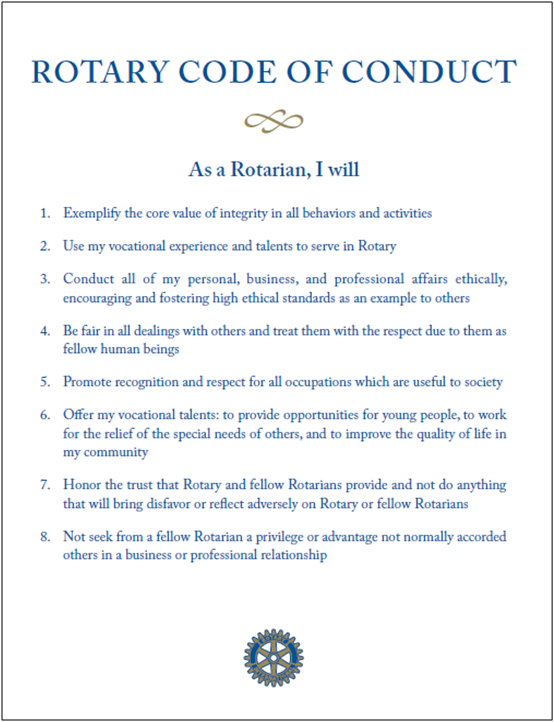
Emphasize the connection between the Four Way Test and the Rotary Code of Conduct (formerly called: Declaration of Rotarians in Business and Professions) and their importance to the values of Rotary.
When professionals join a Rotary club, they do so as a representative of their classification – their particular business or profession.
Rotarians have the dual responsibility of representing their vocation within the club and exemplifying the ideals of Rotary within the workplace.
One of the central goals of Vocational Service is to promote and advance Rotary’s high ethical standards. Two useful tools Rotarians have to assess these standards are The Four-Way Test and The Rotary Code of Conduct.
A great way to share information about your vocation is to give a classification talk or presentation at a club meeting.
We would like to invite ALL eClub of Houston members to share a brief Classification talk thru a short video, images and/or text sent to our Newsletter Editing team and to be published in our future 2017-18 newsletters. Thank you!
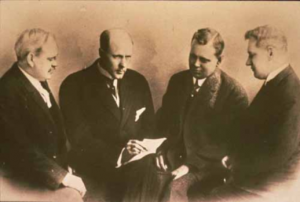
Background When a lawyer named Paul Harris, a coal dealer, a mining engineer, and a merchant tailor first met in 1905 in Chicago, they gave birth to Rotary and, by the nature of their diverse occupations, to the association’s most distinctive feature – the classification principle. Today, the classification principle, though modified, remains a cornerstone of Rotary. Upon joining Rotary, you are lent a classification by the Board of Directors to reflect your occupation or primary source of income. By limiting active membership by classifications, each club becomes a cross-section of the business and professional life of the community it serves. Also, the classification principle makes sure that no one profession or business becomes the dominant force within the club.
Another benefit of the classification system is that representatives of many fields are brought together, providing the opportunity for Rotarians to broaden their knowledge of the contemporary workplace. This, in turn, enables Rotarians to fulfill one of the basic obligations of vocational service – recognizing the worthiness to society of all useful occupations.
The guidelines below are designed to help you prepare and give a good presentation.
Preparing your Classification Talk/ Presentation Write an outline of points you want to cover. Go from general characteristics of your career field to the specific duties involved in your particular job today. Examples might include:
Why you chose your particular business or profession
Parts of your job you find most rewarding and most difficult.
Forecast employment opportunities in your field for the coming decade.
Advice you would give persons entering your career field.
How your profession is being impacted by technology, government regulations, and environmental factors.
Ethical issues you face at work, and how the Rotary 4-Way Test and the Rotary Code of Conduct helps you deal with them.
Know your Rotary Audience
Rotary is a professional business service culture based on farming or cultivating relationships and not hunting for business. This means that Rotarians are not there at a meeting to be “pitched” or sold to. The purpose behind a Rotary Classification Talk / Presentation is to first educate your audience about your profession and to demonstrate your credibility through your knowledge of your vocation. Once Rotarians are comfortable with you and have gotten to know you, they will engage in professional business relationships with you or assist you in building your business. Always keep in mind, The Object of Rotary is to encourage and foster the ideal of service as a basis of worthy enterprise and, in particular, to encourage and foster:
FIRST. The development of acquaintance as an opportunity for service;
SECOND. High ethical standards in business and professions; the recognition of the worthiness of all useful occupations; and the dignifying of each Rotarian’s occupation as an opportunity to serve society;
THIRD. The application of the ideal of service in each Rotarian’s personal, business, and community life;
FOURTH. The advancement of international understanding, goodwill, and peace through a world fellowship of business and professional persons united in the ideal of service.
Presenting your Classification Talk/ Presentation
Speak clearly and in an audible tone – stick to your prepared text or outline
Use hand movements sparingly –avoid nervous habits such as coughing or twitching.
Maintain eye contact with your fellow Rotarians and always face your audience.
Avoid the urge to rush though your 3-5 minute talk or 20-30 min presentation to “get it over with.”
Try to relax as much as possible and put genuine emotion into your voice.
Visuals such as PowerPoint can enliven your talk. Be sure equipment is at our meeting place with a technician familiar with your plans. The Rotary club coordinator can be helpful at the time of your equipment set up before the meeting.
How you share information about your profession is up to you! Relax and enjoy your opportunity to educate your fellow Rotarians about your vocation.
Test, this is only a test...Our 2017-18 President Wind Nguyen started to create a magazine for our eClub as a test, to see if this format is attractive to its members. Take a look...
Flipboard is a news aggregation and social network aggregation company based in Palo Alto, California, with offices in New York, Vancouver and Bejiing. Its software, also known as Flipboard, was first released in July 2010. It aggregates content from social media, news feeds, photo sharing sites and other websites, presents it in magazine format, and allows users to "flip" through the articles, images and videos being shared. Readers can also save stories into Flipboard magazines. As of March 2016 the company claims there have been 28 million magazines created by users on Flipboard.[citation needed] The service can be accessed via web browser, or by a Flipboard application for Microsoft Windows and macOS, and via mobile apps for iOS, Android and Windows Phone. The client software is available at no charge and is localized in 21 languages. Its current headquarters is located at 735 Emerson St, Palo Alto, CA 94301, recently moving from a nearby building.
ROTARY VOICES: Corporate membership: What has worked for us and what hasn’t
Rotary International/Dec 19, 2016
Corporate membership has helped the Rotary Club of Melbourne, Victoria, Australia, attract senior business leaders.
By Robert Fisher, Rotary Club of Melbourne, Victoria, Australia
As the first club chartered in Australia, we have a membership of around 250 people. We had two ‘champions’ who were keen to introduce corporate membership. Over several years, they sought acceptance of this category in the upper layers of Rotary, and eventually were given the go-ahead to try it as part of a pilot project in 2011.
Motivators
We saw corporate membership as a way to uphold our club’s long tradition of attracting the most senior members of Melbourne’s business community, and tap into corporate networks to use their expertise to enhance our social programs. It was our belief that we could achieve significantly greater impact by getting entire corporations involved. We are able to offer them access to a highly respected service organization, and opportunities for their staff to put in volunteer hours and engage in projects.
Five years on
We currently have 17 members from six organizations. RI, district and Rotary Down Under dues are paid for each corporate member as if they were ordinary members. We aim to have just one corporate partner per industry or field. Professional services, banking, and higher education are among some of the industries that are represented. (One member dropped out last year due to lack of senior level connection, and probably inadequate relationship management on our part.)
Our corporate members are engaged in one or more of our projects such as homelessness, domestic violence, and clean water. While they are enthusiastic contributors, the greatest challenge is getting and keeping their attention. They all have extensive time commitments. Attending regular lunch meetings is not easy for them, so we run less frequent and more informal evening meetings to provide them an additional option to keep in touch. Also, our club has a corporate team which meets quarterly with all the corporate members to provide updates and identify potential areas of cooperation.
What have we learned?
Perseverance and focus are required to ensure that the expectations of corporate members are met. This requires constant efforts to maintain close relationships with the corporation and the individuals. We have found that it is better to get prospective corporate members excited in projects first, rather than just focusing on adding members.
Even with its challenges, we have found corporate membership to be highly beneficial.
$18,000 Hole-in-one Closest to the hole Bubba Hole $20 Mulligans $5 Door Prizes Raffle Lunch
Join us Monday, August 7th at the Clear Creek Golf Club as we host our 4th annual golf tournament. Funds raised support projects benefiting youth in the Spring Branch School District.
Who benefits? SBISD students in need of financial support to attend college - to be the first grads in their families. Various other charities you've seen on these pages over the years. AND YOU! Take a day in the sun with friends and clients, while doing some good. Contact Carter Franklin for details, Carter.Franklin@SBCGlobal.net
About
The Rotary Club of Memorial-Spring Branch is a group of local business people and volunteers dedicated to helping people here and around the world.
General Information
Our Club meets at the Houston Racquet Club at noon on Fridays. The cost for lunch is $20. You are invited to attend. We are an inclusive club and welcome new members.
Great! Now click on the Membership Application in the bar above which is a Google online document. Complete the application and press send, it will arrive to our club Membership Chairman as shown below.
On the membership application you will be asked if you have attended two Rotary e-Club of Houston meetings on-line. Look for the Weekly Program and either view the video or read the article, then go to the tab for Weekly Meeting beneath the banner of the page and submit the attendance form to receive credit.
If you have any questions, please email Tiffany Cady at tiffany@angelpetshouston.com . We look forward to getting to know you and working together on service projects wolrdwide as we live our Rotary Motto of "Service Above Self".
Tiffany Cady
Membership Chair 2017-18 Rotary e-Club of Houston, Texas, USA
To pay your membership dues: By credit card, please click on the PayNow yellow link on the left side of the home page. By check: Please mail it to Alexis Campestre, Club Treasurer 2017-18,(address TBA soon) and just submit your application from our online blue button here on top of our website!
The Four-Way Test is a nonpartisan and nonsectarian ethical guide for Rotarians to use for their personal and professional relationships. The test has been translated into more than 100 languages, and Rotarians recite it at club meetings.
Of the things we think, say or do:
First, Is it the TRUTH? Second, Is it FAIR to all concerned? Third, Will it build GOODWILL and BETTER FRIENDSHIPS? and Fourth, Will it be BENEFICIAL to all concerned?











.jpg)

.jpg)



.jpg)