Warmest Wishes for Happy Holidays and a Happy New Year! Our Jewish friends have celebrated Hanukkah from December 6th to December 14th. Our Christian friends will be celebrating Christmas this week on December 25th. Kwanzaa will be celebrated beginning December 26th through January 1st. Rotary International is an international service organization whose stated human rights purpose is to bring together business and professional leaders in order to provide humanitarian services, encourage high ethical standards in all vocations, and to advance goodwill and peace around the world. It is a secular organization open to all people regardless of race, color, creed, religion, gender, or political preference. There are 34,282 member clubs worldwide. 1.2 million individuals called Rotarians have joined these clubs. We are committed to "SERVICE ABOVE SELF" as our motto. During the holidays Rotarians are quite visible in their communities spreading goodwill and building better friendships, honoring senior citizens, sharing gifts with children from families in need, feeding the hungry, adopting families and more. It simply feels good to know that you have made a difference to others. Wishing you and yours a joyous time with family and friends during our holidays and a prosperous new year to continue serving others through our gifts of time & talent and money we have earned to support club projects and the Rotary Foundation.
Rotary Club of Santa Rosa (California): The Rotary Club of Santa Rosa's 2015/16 theme is “Real People, Real Impact”!
(1) Children's Christmas Program: Each year the club sponsors a group of local children to attend the Nutcracker at the Spreckle’s Theatre. Prior to the performance, club members shop for Christmas gifts for the children and then wrap them at one of our club meetings. After the performance, Santa Clause will be in attendance handing out gifts. A good time is had by everyone.
(2) Poinsettias for Vigil Lights Senior Housing - Members donate poinsettia plants for the seniors at this facility
(3) Christmas Feast - Each year, Santa Rosa Rotarians and family members descended on the Sonoma County Fairgrounds to participate in another Hands On Project. This project involved helping the combined Redwood Gospel Mission and Salvation Army to provide hot meals, haircuts, food boxes, and Christmas gifts to those in need in our community.
A blue sea of Rotarian At Work shirts could be seen at the food boxing area where members placed a frozen chicken and other food staples into a cardboard box for families to take home to make a Christmas dinner. After the food was boxed, some more members rolled the boxes down a conveyor line where yet some more members had the filled boxes placed in a shopping cart. Each Rotarian is then assigned a family to either deliver the box of food to the family’s car, or to take the shopping cart to receive bags of gifts for children of all ages.
The event is a huge success each year. Attendance at the event has been estimated to be approximately 5,000 people, not including all of the hundreds of volunteers. The sparkle of eyes and huge grins of children learning that the bags are full of Christmas presents is a sight that none of the members there will ever forget. The shopping carts full of boxes of food and Christmas gifts are then wheeled by Rotarians all of the way out into the recipients’ cars.
Rotary Club of Toronto (Canada) - We held our 86th annual Christmas Party for Children with special needs. For all the children and their families, there was face painting, crafts, scrapbooking, and a raucous snowball fight with the police. Fortunately the police men and women wore their vests as they took quite a beating from the kids. Several Rotary exchange students became clowns and elves for the day and added a truly international flavour to the party. Santa arrived to make sure all had presents and a chance to have a photograph with Santa.
This year’s party drew 235+ children and their families from the following groups:
Easter Seals Society
Canadian National Institute for the Blind
Bob Rumball Centre for the Deaf
Holland Bloorview
Gilda’s Club of Greater Toronto
Starlight Foundation of Canada
If we ever get to wondering whether it is all worthwhile to take the time we do, away from work and family to do the great work of Rotary, I leave you with a note of appreciation that we received from the parent of one of our disabled child guests: “I just wanted to say a big thank you for the opportunity to attend Saturday's party. My son and I had a great time and made some great memories with friends. It was our first time attending, but won't be our last.
I don't know who to share our gratitude with so am hoping you can get this note of thanks to the right folks.
All of the volunteers were so kind and warm at each turn. Hotel staff made us feel welcome and special the moment we entered to time we left. Our police escort to the party was lovely. He especially loved the "snowball" fight, dancing and story time. Sometimes the thought of attending stuff like this can be stressful, but nothing about this was stressful. Well, except sitting on Santa's knee, but my son did it after not doing it for three years so big deal for us and we now have a great photo memory of his uncertain, but very brave moment. He has proudly looked at that picture a few times since the party. Big thank you to everyone involved. Everyone helped make a very special day for at least one four-year-old and his Mom. Thanks again!”
Rotary Club of Battersea Park(United Kingdom)- In London area alone there are over 60 clubs, of which the Rotary Club of Battersea Park and other Rotary clubs in the Wandsworth area – Balham, Putney, Tooting and Battersea – are some of the most active, particularly at Christmas.
What volunteers do:
On Christmas Eve we set up in the morning and make sure all is ready for the great day ahead.
On Christmas Day we will be sending out about 60 buses to pick up our guests, many of whom will be in wheelchairs.
Making fresh sandwiches as a take away supper for our guests.
Help is needed in the kitchen working with the chefs to prepare lunch.
Bring good cheer with a happy Christmassy welcome when the guests arrive.
Serve tea and coffee and, later on, sherry before lunch.
Help serve lunch – no joke when 450+ full 3-course Christmas dinners need to arrive on the table at the same time hot and delicious.
Serve a glass or two of wine with lunch.
Help clear tables and help with the washing-up
Have lunch yourself – the full works and its absolutely free (well, it is your Christmas Day too!).
Help the elderly guests enjoy the afternoon’s entertainment which is great fun – dancing, sing-alongs and bingo. They love to have a chat with a friendly person, so sit down and listen.
Clear tables at the end of the day and ensure the marquee and kitchens are left spotless.
On Boxing Day you can help finish off tidying up followed by a pub lunch to celebrate a successful Christmas Day for the Elderly.
•The traditional three colors of Christmas are green, red, and gold. Green has long been a symbol of life and rebirth; red symbolizes the blood of Christ, and gold represents light as well as wealth and royalty.
•All the gifts in the Twelve Days of Christmas equal 364 gifts.
•Each year more than 3 billion Christmas cards are sent in the U.S. alone.
•Christmas trees have been sold in the U.S. since 1850.
•Christmas trees usually grow for about 15 years before they are sold.
•Bolivians celebrate Misa del Gallo or “Mass of the Rooster” on Christmas Eve. Some people bring roosters to the midnight mass, a gesture that symbolizes the belief that a rooster was the first animal to announce the birth of Jesus.
•The British wear paper crowns while they eat Christmas dinner. The crowns are stored in a tube called a “Christmas cracker.
•n Poland, spiders or spider webs are common Christmas trees decorations because according to legend, a spider wove a blanket for Baby Jesus. In fact, Polish people consider spiders to be symbols of goodness and prosperity at Christmas.
•The poinsettia is native to Mexico and was cultivated by the Aztecs, who called the plant Cuetlaxochitl (“flower which wilts”). For the Aztecs, the plant’s brilliant red color symbolized purity, and they often used it medicinally to reduce fever. Contrary to popular belief, the poinsettia is not poisonous, but holly berries are.
•In Germany, Heiligabend, or Christmas Eve, is said to be a magical time when the pure in heart can hear animals talking.
•The Viking god Odin is one precursor to the modern Santa Claus. According to myth, Odin rode his flying horse, Sleipnir (a precursor to Santa’s reindeer), who had eight legs. In the winter, Odin gave out both gifts and punishments, and children would fill their boots or stockings with treats for Sleipnir.
•According to the United Nations Children’s Fund (UNICEF), there are 2,106 million children under age 18 in the world. If there are on average 2.5 children per household, Santa would have to make 842 million stops on Christmas Eve, traveling 221 million miles. To reach all 842 million stops, Santa would need to travel between houses in 2/10,000 second, which means he would need to accelerate 12.19 million miles (20.5 billion meters) per second on each stop. The force of this acceleration would reduce Santa to “chunky salsa.”g
"Everybody can be somebody who can really make a difference in this world" and "Peace on Earth" are the messages shared by Raul Midon (filmed in March 2007 at TED2007). Guitarist and singer Raul Midon blends flamenco, jazz and R&B to create a category-defying sound. His life story is as inspiring as his musical vision.
Why you should listen
Raul Midon is into beating the odds, shattering stereotypes, and making category-defying music. "I was told as a child, 'You're blind; you can't do this,'" Midon told an interviewer in 2005. "I was told when I moved to New York, 'You can't do that, you're not going to make it.'" At 40, however, Midon has clearly made it.
After singing backup vocals for stars like Shakira, Julio Iglesias, Jennifer Lopez and Christina Aguilera, Midon released his major-label solo debut, State of Mind, with help from guest artist Jason Mraz. Midon's innovative songwriting incorporates his lyrics, guitar handiwork (jazz, classical, flamenco, R&B) and "vocal trumpet" improvisation. Though he draws comparisons to Stevie Wonder, Donny Hathaway and Richie Havens, Midon is the rare original in an industry of few.
Taliban Join Global Effort to Kill Off Polio in 2016
n the final battle against one of humanity’s oldest and most-feared maladies, an unlikely ally has emerged: the Taliban.
The insurgent group, whose anti-government attacks have stoked insecurity in Afghanistan and hampered vaccinators, is working alongside local and international health authorities to wipe out the last vestiges of polio, marshaling thousands of people to immunize vulnerable children.
In the country’s Taliban-controlled areas, their cooperation is crucial. Cases worldwide of poliomyelitis, as the disease is known, have dropped this year to the lowest in history. The crippling disease may be eradicated entirely by the end of next year if children can be protected where they were previously deemed too risky or difficult to reach. Villagers in some of the most remote areas are now “very willing” to be freed from the ancient scourge, said Obaidullah Elaj, a doctor working for the Taliban in southern Afghanistan.
“It’s a dreaded disease and requires collaboration from all parties to fight,” said Elaj, who acts as an intermediary between the group’s negotiators and World Health Organization officials. “I am 100 percent happy to work alongside WHO and the government to fight polio, a disease affecting children in our isolated areas.”
High Stakes
After 26 years and an investment of more than $11 billion, polio cases worldwide were reduced to 359 in 2014, from an estimated 350,000 in 1988. Apart from 17 wild poliovirus cases in Afghanistan, only 49 others have been reported this year -- all of them in neighboring Pakistan. That leaves only two countries where polio transmission has never been stopped.
After the death of Osama bin Laden in 2011 by U.S. forces with the cooperation of a doctor in Pakistan, polio workers and doctors were seen as spies by the Taliban and became specific targets with more than 100 of them killed or wounded in Afghanistan, said Hedayatullah Stanekzai, a senior adviser with the country’s health ministry. Since 2012, 32 health care workers and other personnel involved in polio eradication have been killed in neighboring Pakistan, the WHO said this month.
That suspicion no longer exists in Afghanistan, said Elaj, the Taliban doctor.
The Taliban in Afghanistan released a statement in 2013 supporting all health programs in the country, including polio eradication. The cooperation is part of an effort to build trust among the general population, researchers said in a 2013 study on the challenge of violence in the final push to snuff out the disease, which has maimed and killed for much of human history.
No Spies
“We are not worried about the possibility of spies being among vaccinators because these are trusted people, introduced and hired on our recommendation,” Elaj said in a telephone interview from Kandahar. The following day, the medic appeared at a public health office in the city. A tall, bearded man, he wore a long tunic over trousers with a traditional blanket scroll tied to his body.
The “quality” of the Taliban’s polio campaign can’t be verified because there is no way to check that every vulnerable child is being vaccinated, the health ministry’s Stanekzai said.
That’s because the Taliban’s participation in the program, negotiated with public health officials and the International Committee of the Red Cross, comes with a condition: that their own people do the vaccinating in Taliban-controlled areas, said Mohammed Soghaier, a WHO doctor in an interview in his office in Kandahar.
Own Vaccinators
“Some areas are inaccessible except for Taliban, so we are requesting them to provide their own people or offer local people from these faraway areas to work with us,” Soghaier said. “Not one of these groups is against polio vaccination. They are cooperatives, they trust us.”
In the 1990s, the United Nations Security Council criticized the Taliban regime for abusing women and harboring members of al-Qaeda. The Taliban and other illegal armed groups in Afghanistan still threaten locals, foreigners and security forces operating in the country, the council said on Friday.
Still, polio won’t be eradicated without the Taliban’s help. There are about 500,000 children younger than 5 years in Afghanistan who aren’t fully immunized against the virus, a quarter of whom live in areas deemed inaccessible to vaccinators, according to the WHO. Decades of war, insurgencies and border skirmishes, combined with one of the weakest health systems in the world, have allowed the virus to persist.
“There is no clinic or hospital in the Taliban-controlled areas,” said Elaj, the Taliban doctor. “Health services are in devastating condition and people die from sickness at home or on the way to health facilities in the city.”
Two Taliban Groups
While Taliban groups in Afghanistan and Pakistan share the same name, operationally they have different goals and structures. The Afghan Taliban took power in the 1990s and received diplomatic backing from only two countries, Pakistan and Saudi Arabia, before the U.S. invasion in 2001. Top members received shelter in Pakistan for years, and the U.S. State Department now sees the group as being an “important partner” in a peaceful Afghan-led reconciliation process.
The Pakistani Taliban, on the other hand, is a collection of militant groups along the Afghan border that united in 2007 under the name Tehrik-e-Taliban Pakistan. The group, which the U.S. considers to be a terrorist organization, regularly attacks Pakistan government and military installations, and wants to impose its version of Sharia law in the country.
A spate of attacks this month show that parts of Afghanistan remain an active battle zone, even after gains made this year by the Afghan Taliban prompted the U.S. to reverse plans to withdraw most troops from the country by the end of 2016.
Taliban’s Birthplace
Kandahar, the Taliban’s birthplace, was at the center of a polio outbreak in 2011 that infected 80 people. Now, Afghanistan’s second-largest city and its province are free of the virus, an achievement gained with the cooperation of Taliban fighters, said Stanekzai, the health ministry adviser.
In male-dominated Kandahar, about 100 women dressed in blue burqas that cover their faces and bodies, move from house to house to find children to vaccinate.
Beheading Risk
“Working within the city is safer for us than going out to the villages,” said Wajia, a 19-year-old student, as she administered a dose of vaccine to a child on a dusty, unpaved lane bordered by a fetid sewer. “The Taliban would have already beheaded me if I’d gone there to vaccinate their children.”
About 80 percent of the 10,000 people immunizing children in southern Afghanistan are Taliban-appointed, said Najibullah Zafarzay, a WHO health coordinator in Kandahar. Besides “well-trained” vaccinators, the Taliban’s polio teams include supervisors, coordinators and social mobilizers who raise awareness about the disease, he said.
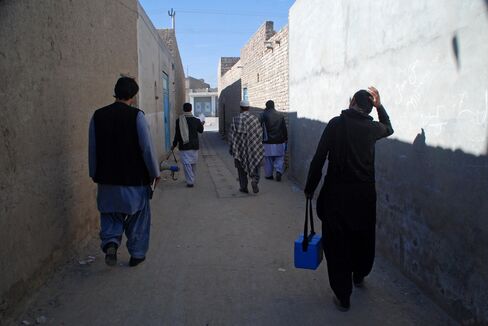
A polio team in Kandahar
Photographer: Eltaf Najafizada/Bloomberg
Vaccinators, who are paid 300 Afghanis ($4.50) a day, go from house to house in hundreds of southern villages, delivering two drops of oral polio vaccine in the mouths of every baby younger than a year old -- or about 1.6 million infants, Zafarzay said. Children under 5 receive an inactivated polio virus shot in village health facilities.
Bill Gates
Eight to 12 vaccination rounds are planned for Afghanistan this year. Each will deploy some 54,000 vaccinators, target 9 million children, and cost international donors, which include the Bill and Melinda Gates Foundation, Rotary International and USAID, about $3.6 million, Stanekzai said. Active fighting and hostilities caused by the Islamic State threaten the security of polio workers and deprive about 120,000 children of vaccine, he said.
Immunization coverage averages about 60 percent nationally, but drops as low as 40 percent in some southern areas -- well below the 80 percent needed to stop transmission.
New Weapon
Polio paralyzed millions of people worldwide in the 20th century before vaccines became widely available from the mid-1950s. In 1952, almost 60,000 cases with more than 3,000 deaths were reported in the U.S. alone.
World leaders resolved in 1988 to wipe out polio, prompting the WHO, United Nations Children’s Fund, Rotary International and the Centers for Disease Control and Prevention to form the Global Polio Eradication Initiative. They expected to finish the job in 12 years -- the same time it took to stop smallpox.
Polio, though, is a more difficult virus to eradicate because fewer than 1 in 100 people who catch it show signs of illness or are aware of the infection, enabling the virus to spread undetected, usually when someone eats food or drinks water contaminated with the feces of an infected person.
The virus’s most stubborn stronghold is Pakistan’s Peshawar region. Bordering Afghanistan, it’s a vast interconnected area described as the “conveyor belt” of polio transmission because of the ease in which the virus has moved between both countries, creating a viral reservoir.
“The large population movements from Afghanistan and Pakistan pose an incredible risk of international spread of polio beyond those two countries,” said Annelies Wilder-Smith, a professor of infectious diseases at Singapore’s Nanyang Technological University, who has served on a WHO emergency committee for polio. “In the past years, great efforts have been undertaken to increase vaccination coverage, but still more needs to be done.”
Exported to Syria
Infected travelers from the two nations threaten to seed outbreaks in countries where protection from immunization is weak. In 2013, 35 children were paralyzed in Syria after a virus originating from Pakistan touched off the Mediterranean country’s first polio outbreak in 14 years.
If the virus isn’t stopped next year, with global eradication officially certified by 2019, governments and donors will be hobbled with about $800 million a year in costs associated with continued vaccination and surveillance, said Sona Bari, a spokeswoman for WHO’s polio program in Geneva.
Afghanistan now requires all travelers younger than 5 years entering the country from Pakistan to receive the polio vaccine. At certain border points between Afghanistan and Pakistan, all travelers under 10 are being immunized to protect refugee populations who have a history of missed vaccinations.
Dangerous Work
The constant flow of people across the border is a major challenge, said Soghaier, the WHO doctor in Kandahar. At police check points, teams vaccinate about 3,000 children a day.
It’s dangerous work. One member of the transit team was killed after a Taliban suicide attacker targeted police checkpoint in Helmand province, he said.
Soghaier says he tries not to allow politics to get in the way of achieving the common goal of eradicating polio. “By collaborating with different groups and parties, we are simply implementing the operational guidelines,” he said. “It doesn’t matter if a village is controlled by anti-government elements, the government, or the Islamic State -- this is a social issue and we are keeping our program neutral to save every vulnerable child.”
Polio remains endemic in two countries – Afghanistan and Pakistan. Until poliovirus transmission is interrupted in these countries, all countries remain at risk of importation of polio, especially vulnerable countries with weak public health and immunization services and travel or trade links to endemic countries. Circulating vaccine-derived poliovirus is causing an outbreak in Madagascar, Guinea and Ukraine.
- See more at: http://www.polioeradication.org/Keycountries.aspx#sthash.nOrZJQBj.dpuf
Polio remains endemic in two countries – Afghanistan and Pakistan. Until poliovirus transmission is interrupted in these countries, all countries remain at risk of importation of polio, especially vulnerable countries with weak public health and immunization services and travel or trade links to endemic countries. Circulating vaccine-derived poliovirus is causing an outbreak in Madagascar, Guinea and Ukraine.
- See more at: http://www.polioeradication.org/Keycountries.aspx#sthash.nOrZJQBj.dpuf
As the Rotary Clubs in Korea have grown with the number of clubs in the hundreds and individual membership in thousands, Seoul Rotary Club is proud of its unique status in that history. As the first Rotary Club in Korea, and one which continues to use English as the official language, Seoul Rotary Club continues its proud tradition within the larger Rotary International organization. As we progress into the twenty-first century, Seoul Rotary Club plans to transform itself as the vibrant and welcoming gateway between the global Rotary International membership and the local Korean Rotary Clubs.
The history of the Seoul Rotary Club embodies the history of Rotary Club in Korea as well a slice of twentieth century Korean history itself. As the first Rotary club in Korea, Seoul Rotary Club had its genesis during the Japanese colonial period under a different club name - Keijo Rotary Club. The club was dissolved under Japanese military pressure during the Second World War. However, this allowed its reestablishment under the new Republic of Korea under its current name of the Seoul Rotary Club. A year after the rebirth of the Seoul Rotary Club, the outbreak of the Korean War and its turmoil caused the members to temporarily flee to Busan. Like Korea itself, the Seoul Rotary Club has weathered these hardships and continued to grow and prosper, accomplishing its mission for the betterment of society through its credo: "Service Above Self".
The genesis of the Seoul Rotary Club can be traced to the initiative of Bishop H.R. Boaz of the Southern Methodist Church, who was assigned to Seoul. In 1922, Bishop Boaz wrote to Rotary International to inquire into the possibility of forming a Rotary Club in Seoul with his friends and associates. Bishop Boaz and his group were planning to call it the ¡°Seoul Rotary Club¡±. However, this original plan never came to fruition due to intervening events.
A group of Japanese businessmen heard about the plan of Bishop Boaz and formed an alternative plan to start a Rotary Club. These businessmen approached the Japanese Governor-General, Saito Minoru, to enlist his support for their plan. The plan was to name the club the ¡°Keijo¡± (pronounced ¡°Kyung Sung¡± in Korean) Rotary Club, which was the name for Seoul during the Japanese colonial period. These Japanese businessmen advocated against Bishop Boaz¡¯s plan, arguing that a Rotary Club centered on a Christian missionary would not be beneficial and only attract second-tier businessmen. They advocated a plan to form a club made up of elite businessmen of their day. Governor-General Saito took the lead in promoting their plan, which eventually led to the establishment of the Keijo Rotary Club in 1927.
The Keijo Rotary Club, the predecessor to the Seoul Rotary Club, filed for membership with Rotary International on August 27, 1927, and received its official Charter on November 10, 1927. It was granted the Rotary International club number 2703. The original charter membership consisted of 21 members, of which 17 members were Japanese, and 4 members were Korean. The 4 Korean members were: Sung Soo Kim (President of Dong-A Ilbo Daily and Founder of Korea University), Sang Yong Han (President of Chosun Fire Insurance), Yong Joo Kim (Editor-in-Chief of Seoul News), and Sang Kyu Baek. The membership grew steadily to 52 members by 1934.
The advent of the Second World War brought an end to the Keijo Rotary Club with the formal cancellation of its charter by Rotary International on February 14, 1941. The Japanese military put pressure on the government to close down organizations that were deemed to promote western ideas or culture. Bowing to such pressure, the Keijo Rotary Club filed for cancellation of its charter, thus formally ending its existence under the Japanese colonial period. However, while there was no longer any official ¡°Rotary¡± club in Korea, many members continued to meet regularly under the new name of ¡°Wednesday Club¡±.
After the end of the Second World War, Korea gained its independence as the Republic of Korea, and with it the reestablishment of the Seoul Rotary Club. In March 29, 1949, a group of 38 organizing members, including Dr. George Fitch of YMCA, met to agree on the reestablishment of the Rotary Club in Korea. On November 10, 1949, they received a reinstatement of the original charter and number from Rotary International under the new name of Seoul Rotary Club. The inaugural president of the Seoul Rotary Club was Dr. Soon Ju Chey (PhD, New York University, 1930), who served as the Governor of the Bank of Korea under the government of President Syngman Rhee, while the Vice-President was Mr. Young Seol Lee.
When the Korean War broke out in 1950, it forced many members of the Seoul Rotary Club to flee to other Korean cities like Busan. The members of the Seoul Rotary Club continued to meet in Busan to hold regular meetings. Members of the Seoul Rotary Club were instrumental in the reestablishment of the Busan Rotary Club in 1952. Seoul Rotary Club and its members have played an important role in the growth of Rotary Clubs in Korea.
These Rotarians are pictured here in a Christmas Party they held at the Sundeaokwon Orphanage.
Seoul Rotary Club has over 50 members including nationals from Korea, U.S.A., Japan, Germany, Ireland and Belgium. The Club language is English. You could also hear Korean, Chinese, Japanese, French, Dutch, German, Italian, and Russian.
Santa Claus is a major figure in the folklore of the Western world. His image has even spread to a few Asian countries such as Japan, whose connections with the West are quite deep and intricate. He has acquired his persona and lifestyle from a number of different cultures over the years, just as Christmas has gathered to itself many aspects that have little to do with the birth of Jesus. Christmas and Santa Claus have much in common in their development from primarily religious origins into the largely secular ideas that they are today. Let us have a meander through history and see just how the legend of Santa Claus, and particularly the Christmas Santa Claus, developed into such an integral part of our culture.
The Beginnings
It would appear that the template for Santa Claus was a 4th century Christian bishop called Saint Nicholas of Myra. Myra was then part of the Byzantine Empire situated in, what is now, Turkey. What connects him to our modern figure is his generosity to the poor in the form of gifts. The key story that caused him to be remembered was his gift of wedding dowries to three impoverished sisters, which saved them from the only other life open to poor, unwedded girls of the time: prostitution. His name and fame filtered into Europe over the centuries and he was particularly revered in the Netherlands, Belgium, Austria, and Germany. We shall see later that the Dutch brought him to America in the 17th century. Their spelling of his name: Sinterklaas, is the ancestor of our Santa Claus.
The Korea convention’s Host Organization Committee (HOC) is giving us a red-carpet welcome with events that include a 3K Walk for Peace, an evening at the symphony, a contemporary ballet performance, a talent contest, and a welcome festival that will blend modern and traditional Korean music and dance.
Our Rotarian hosts in Korea have also organized tours of the country before and after the convention, as well as half- and full-day tours in and around Seoul. For details on events and tours, visit the HOC website.